The Manual Is Not the Tutorial
A game manual explains controls, but seeing how rules connect to rooms, items, and obstacles helps you understand what to do when a page falls short.
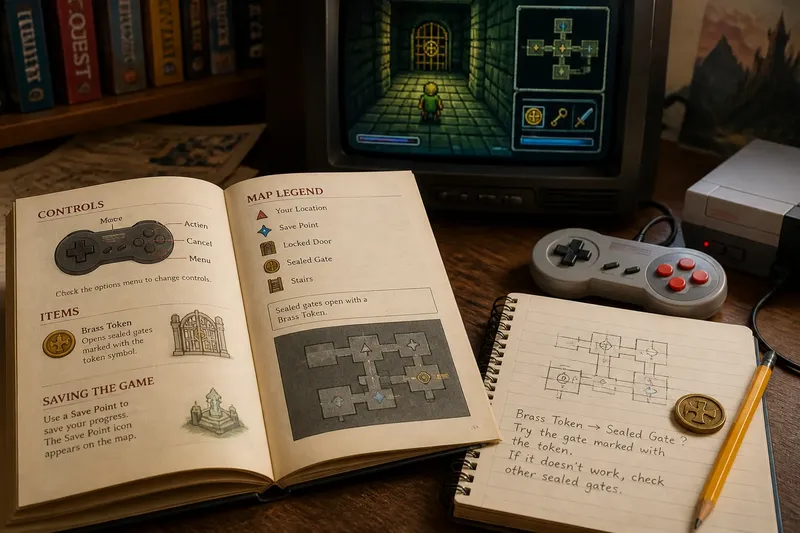
You open a game manual to check how saving works, then find the game’s map uses a symbol the booklet never mentions. The manual can explain its controls, but understanding how its systems fit together often takes a closer look at the game itself. That distinction makes a game manual more useful, not less.
What can a game manual explain?
A manual is strongest when it names information that stays stable: which buttons move or attack, what an icon represents, how to save, or what the broad objective is. It may also introduce characters and setting before the first screen appears. For a game with a sparse interface, those explanations can keep basic questions from interrupting play.
Manuals also work as records of a game’s vocabulary. A booklet might call a move a “charge,” identify a key item, and explain that a door is locked. Those terms give you something to look for as you play. They do not always explain how the game connects one term to another.
Where do manuals leave gaps?
A manual may list a key, a locked door, and a map without showing how the map marks that door or whether the key has another use. The missing piece is not necessarily a control. It is the relationship among objects, locations, and rules.
That kind of connection is often learned by comparing the game’s rooms and menus. A symbol that appears beside a door may match an item in the inventory. A save point may sit near a branching path, changing how you think about which route to explore first. The manual offers names; the game’s layout gives those names a place.
Think of the manual as a set of labeled drawer fronts. The labels help you identify what belongs where, but you still have to open the drawers to see how the contents fit together.
How can you use the manual without treating it as a walkthrough?
Start with instructions that remove practical obstacles, then consult the booklet when a term or system is unclear. For questions the manual does not settle, compare the relevant screens and make one small change at a time.
- Check the control diagram. If the button labels match your controller, use them as written; if they do not, check the game’s control options or the instructions for your version.
- Check the save instructions. If the manual names a save command or location that appears in play, use it; if not, look for a separate save menu or an in-game prompt.
- Check unfamiliar terms. If an item or status name appears in the booklet and on screen, compare the descriptions; if the wording differs, rely on the game’s current prompt and verify the version.
- Check the map legend. If a symbol matches a room or door, use that match to plan where to go; if no match appears, inspect nearby map labels rather than assuming the symbol’s meaning.
- Check whether an item has a stated use. If the manual names a target or effect, look for that target in the current area; if it does not, hold the item while you compare other clues.
- Check the game version named in the booklet. If it matches the title screen or packaging, follow its instructions; if it does not, treat version-specific details as uncertain and check the game’s own menus.
What should you do when a manual leaves a question open?
Should you read the whole manual before playing?
Read the controls, basic objective, and instructions for systems such as saving if those could block you. You can leave story details and unfamiliar mechanics for later, when you encounter them in the game.
How can you tell a rule from a strategy tip?
A rule describes what an action or item does; a strategy tip suggests when it might be useful. If the booklet says an item opens a door, that is a stated function, while using it on a particular door is a choice shaped by the game’s current situation.
What if the manual and game seem to disagree?
Check whether the booklet describes another mode, control option, or edition, then compare its wording with the game’s menus and prompts. If the disagreement concerns a version-specific feature, consult the instructions for that edition.
Can a manual explain every item’s purpose?
Some manuals give a complete list of items, while others name only the basic functions. If an item’s purpose remains unclear, compare its description with the places or characters the game presents as relevant.
How does a worked example help you connect the clues?
Say you are playing an invented adventure game. The manual says a brass token opens sealed gates, and the map marks one nearby doorway with a token-shaped symbol. You open the map, compare that symbol with the door, select the token, and try it there; the gate opens, so the result supports that interpretation. If the gate stays shut, the useful next decision is to keep the token and check whether the map marks another sealed gate, rather than spend it elsewhere on a guess.
This example uses the manual for a stated function and the game for the connection between symbol and location. The same approach works with a menu label, an inventory description, or a map legend: compare the wording, identify the in-game place it may apply to, and choose an action that leaves room to reconsider if the clue does not fit.
Why is a game manual still useful for old games?
When you revisit an older game, its manual can clarify controls, terminology, and systems that the screen explains only briefly. The game manual is especially helpful when you treat it as a reference rather than a complete route through every decision.
If you know the stated rule but not how it connects to a room, item, or menu, compare the relevant clues before acting. That small habit can help you distinguish a missing instruction from a connection the game expects you to make.